
Beryllium Copper
Strips
NGK Berylco Beryllium Copper Alloys
NGK Berylco offers custom-sized beryllium copper strips and coils tailored to your specific requirements and constraints. Each Berylco alloy type provides a unique combination of properties. The choice of alloy depends on your performance criteria in terms of electrical and mechanical characteristics, reliability, durability, miniaturization, and cost-efficiency.
Our experts are here to help you make the right selection!
BERYLCO 25
Cu Be 2
CW 101 C
C17200
Chemical composition
Be: 1.8 – 2.0%
Co: max. 0.3%
Co + Ni + Fe: max. 0.6%
Cu + Additions: min. 99.5%
Remarks
CuBe2 alloy offers a wide range of property combinations, including good electrical conductivity, excellent formability, and very high mechanical strength after heat treatment.
BERYLCO 14
Cu Ni 2 Be
CW 110 C
C17510
Chemical composition
Be: 0.2 – 0.6%
Ni: 1.8 – 2.2%
Cu + Additions: min. 99.5%
Remarks
CuNiBe alloy combining good mechanical strength with excellent electrical conductivity.
BERYLCO 8
Cu Ni 2 Be
CW 110 C
C17510
Chemical composition
Be: 0.2 – 0.6%
Ni: 1.8 – 2.2%
Cu + Additions: min. 99.5%
Remarks
CuNi2Be alloy combining very high electrical conductivity with good mechanical strength.
BERYLCO 7
Cu Ni 2 Be
C17530
Chemical composition
Be: 0.2 – 0.4%
Ni: 1.8 – 2.5%
Al: max. 0.6%
Cu + Be + Ni + Co + Al: min. 99.5%
Remarks
CuNi2Be alloy offering an excellent balance between mechanical strength and electrical conductivity, recommended for high-volume production.
BERYLCO 165
Cu Be 1,7
CW 100 C
C17000
Chemical composition
Be: 1.6 – 1.8%
Co: max. 0.3%
Co + Ni + Fe: max. 0.6%
Cu + Additions: min. 99.5%
Remarks
CuBe1.7 alloy with good mechanical strength after heat treatment, recommended for marine applications.
Heat Treatment
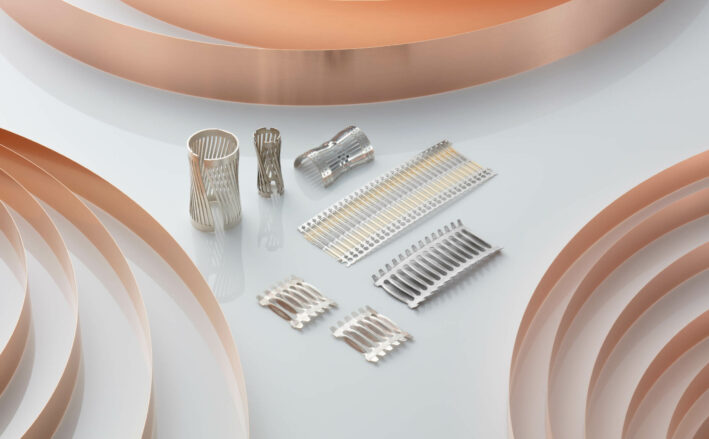
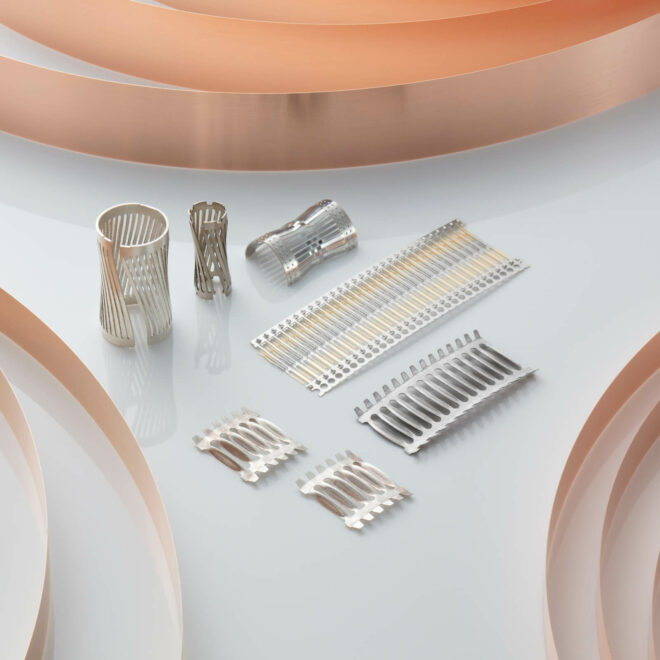
Heat treatment is the most critical process for beryllium copper alloys. While all copper alloys can be hardened by cold working, beryllium copper is unique in that it can also be hardened through a simple low-temperature thermal treatment. This process involves two main steps: the first is known as solution annealing, and the second as precipitation or age hardening.
Solution Annealing
For the standard CuBe 1.9 alloy (1.8–2% Be), the metal is heated between 720°C and 860°C. At this stage, the beryllium is essentially “dissolved” in the copper matrix (alpha phase). A rapid quench to room temperature retains this solid solution structure.
At this point, the material is very soft and ductile and can be easily cold-worked by drawing, rolling, or cold heading.
The solution annealing process is carried out at our facility and is generally not performed by the customer. Temperature, dwell time, and quench rate are critical parameters to control grain size and hardness.
Age Hardening – Precipitation Hardening
Precipitation hardening significantly increases the material’s strength. This reaction is typically carried out at temperatures between 260°C and 540°C, depending on the alloy and the desired properties. During this cycle, dissolved beryllium precipitates as a beryllium-rich (gamma) phase within the matrix and along grain boundaries.
It is the formation of these precipitates that leads to the substantial increase in mechanical strength. The final properties achieved depend on both the aging temperature and the time at temperature.
It is important to note that beryllium copper does not age-harden at room temperature. NGK Berylco products are available in either cold-worked or heat-treated condition.
Temper Terminology
Age-Hardenable (Before Aging) – This condition refers to material that can reach its highest mechanical properties through a simple heat treatment performed after stamping or forming. Proper aging will typically double the strength level.
Fully Aged (After Standard Aging) – This temper indicates that the material has undergone optimal heat treatment to achieve maximum mechanical strength.
Mill-Hardened – These tempers have been pre-aged under controlled conditions at the mill to deliver mechanical properties between the cold-worked and fully aged states. They can be used as-is without further heat treatment by the customer and offer excellent formability. Mill-hardened tempers are also ideal for manufacturing robust miniature parts, minimizing the risk of dimensional distortion during any final aging process.
Elastic Properties and Miniaturization
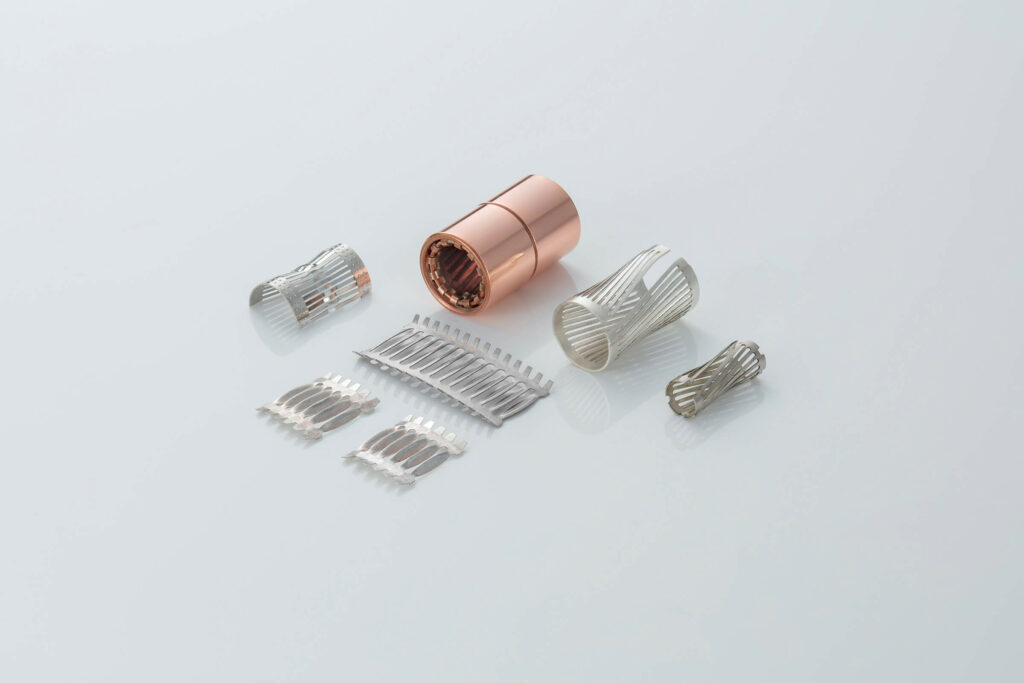
NGK Berylco offers custom-sized beryllium copper strips and coils tailored to your specific requirements and design constraints.
Each Berylco alloy provides a unique combination of properties. The choice of alloy depends on your needs in terms of electrical and mechanical performance, reliability, durability, miniaturization, and cost-efficiency. Our experts are here to guide you.
- Beryllium copper alloys exhibit high mechanical strength and a favorable elastic modulus, making them highly suitable for use as spring materials.
- The elastic modulus, also known as Young’s modulus, is typically measured in the longitudinal direction and corresponds to the slope of the stress-strain curve obtained through tensile testing. It can also be measured directly on flat springs.
- This constant is critical for the design of moving components such as connectors, relays, and sensors.
In general, if the modulus is too high, the contact pressure fluctuates significantly with slight movement. If too low, the necessary contact pressure cannot be achieved. - The yield strength-to-modulus ratio (Rp/Young’s modulus) of beryllium copper is higher than that of stainless steels and other copper alloys. This allows for greater deflection and higher contact pressure.
- By fully leveraging the properties of beryllium copper, component size can be reduced while maintaining equivalent spring force—compared to other copper-based alloys.
Molds and terminals around moving parts can therefore be downsized, lowering the total cost of the final product. - With tensile strength reaching up to 1500 N/mm², beryllium copper enables reduced pin pitch spacing, allowing for higher-density connector designs without changing overall size—ultimately lowering the cost per pin compared to phosphor bronze.
- Using beryllium copper in various applications enables both size and weight reduction. This decreases raw material usage and reduces plating costs.
- When total system costs are considered, beryllium copper offers clear advantages over phosphor bronze.
Formability
Alloys – High Formability at Equivalent Strength
B25 Mill-Hardened ‘Type-B’ and ‘Type-S’ Alloys
Key Characteristics
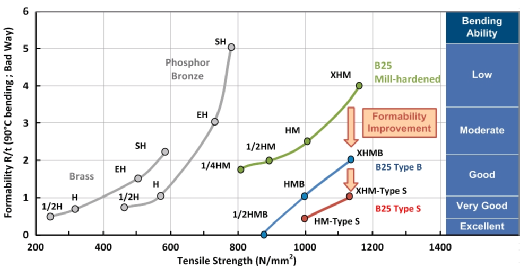
The new Berylco 25 mill-hardened ‘Type-B’ and ‘Type-S’ tempers have been specifically developed to improve formability.
The bend radius ratio (R/t) of ‘Type-B’ is half that of the standard mill-hardened alloy.
The bend radius ratio (R/t) of ‘Type-S’ is one-quarter of the standard, thanks to controlled grain size refinement.
These mill-hardened alloys are delivered in a pre-aged, hardened state. They allow customers to use the material as-is, without the need for any additional heat treatment..
Formability Comparison – 90° Bend Test
Comparison of bend test results between standard B25 HM and the new B25 HMB (‘Type-B’ temper).
The images show the outcome of a 90° bend (longitudinal direction, R/t = 1.0, thickness 0.2 mm). Microcracks are visible on the B25 HM sample, while the B25 HMB sample shows no cracking.
The new ‘Type-B’ and ‘Type-S’ mill-hardened tempers offer excellent formability, while maintaining the same tensile strength of 1000 N/mm².


Formability of New NGK Berylco Strips
| Alloy | Type | Temper | Rm (Mpa) | 90° Bend R/t – Trans. | 90° Bend R/t – Long. |
| Berylco 25 CuBe2 CW101C C17200 | Type B | 1/2HMB | 830 – 930 | 0.0 | 0.0 |
| HMB | 930 – 1030 | 1.0 | 1.0 | ||
| XHMB | 1070 – 1210 | 2.0 | 2.0 | ||
| XHMSB | 1210 – 1310 | 3.5 | 6.0 | ||
| Type S | HM-Type S | 960 – 1040 | 0.5 | 0.5 | |
| XHM-Type S | 1060 – 1220 | 1.0 | 1.0 |
Typical R/t value for 0.15 mm thick sample.
Working on a Beryllium Copper Project?
NGK Berylco UK (DK, GB, IE, IS, NO, SE)
Other countries